
Skipping the Shark
Why the weirdest food is rarely the most real

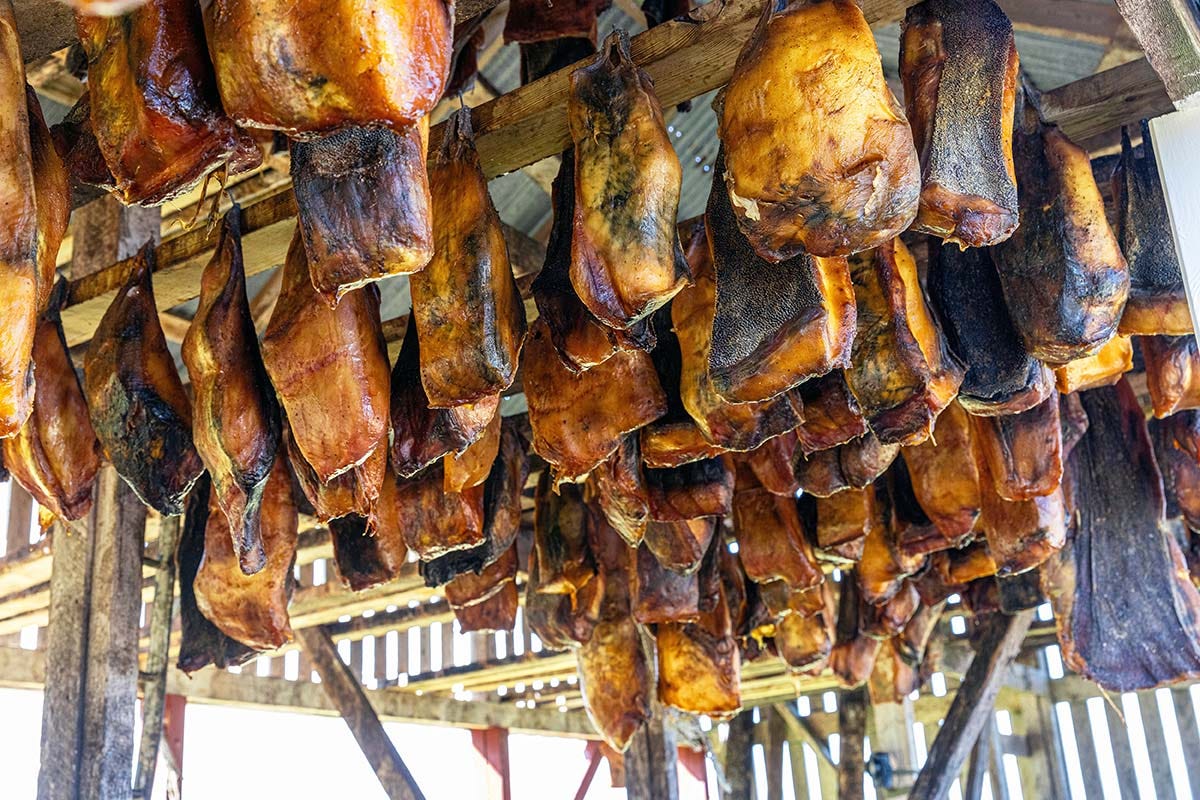
“I’m not eating puffin, I’m not eating whale, and I’m not eating that shark.”
My brother Fred was adamant about this. So was I. I’m with ya, bro. I’m with ya.
Fred’s reasoning was sensibly rooted in the fact that the flavors of these three Icelandic foods range from oddly beefy-briny, to fishy and greasy, to downright horrific. My reasoning was a bit more complex.
I am certainly not the guy to tell you to not eat odd foods. Far from it. I’ve eaten everything from insects in Mexico to beaver tail in Montana to a random coati a fellow hunter shot in Arizona.
I’ve eaten sea ducks, which are basically puffins, and have had plenty of fermented fish; hell, I’ve even made my own rakfisk, fermented trout. As for whale, thanks to an old sourdough from Alaska who wanted to challenge my palate, I got a chance to eat bowhead whale a few years back. So I have a pretty good frame of reference for these Icelandic “treats.”
Weird doesn’t faze me.
What irks me is that these foods, along with Scottish haggis to some extent, have become hackneyed, often ostentatious tourist theater — not nourishment, not cultural appreciation, not even quiet curiosity. Add to this the fact that two members of the Icelandic trio (the shark and the puffin) are considered threatened, and yeah, I’ll pass.
More than once I watched tourists snigger and laugh and dare each other to “try the shark,” or a plate of puffin, or a minke whale steak, served rare of course. And you can’t swing a dead sheep in Edinburgh without seeing a touristy pub offering “traditional haggis.”
It’s rarely about savoring the food itself, or trying to get a sense of what locals actually eat. It’s usually all about the photo, the funny story they’d already had half-written in their heads before they took the first bite.
Sitting at The Icelandic Bar in Reykjavik, my brother and I were eating a simple lunch of soup, seafood, smoked lamb — and one odd bit: an order the crispy fried cod skins, because, well, I make crispy fish skins on the regular.
I got up to pour myself some coffee at the communal urn and saw a young woman, probably a student, sipping her mug, doing her homework. A bowl of lamb stew next to her. A slice of rye bread.
When I sat down, I saw that scene’s opposite: Eight tourists, looking like they’d just walked out of a Patagonia fire sale, each holding up the telltale toothpicks topped with tiny cubes of hákarl, the infamous fermented shark. They were giggling and egging each other on. One man said it didn’t count unless they chewed.
One, two, three! They all chewed it down, to much fake retching (or maybe it was real), and selfies all around.
I looked up at the woman, sipping her coffee, just in time to see her eyes roll. She’d seen this movie before.
Honestly, if you want to understand Iceland, skip the shark and order the cod. Eat lamb that grazed the old lava fields. Taste the skyr. Seek out rye bread baked with geothermal heat. Drink strong coffee with a cardamom roll. Those are the foods Icelanders live with, not just the ones visitors photograph.
Turns out that fewer than two percent of Icelanders eat whale with any regularity, and more than 85 percent don’t eat it at all. Puffins are eaten a bit more often by Icelanders, but it’s a special meal eaten once in a great while, and not by everyone. The majority of each are eaten by tourists.
This raises the unsettling question: If that’s the case, then who’s really responsible for the anachronistic whaling still done in Iceland? Seems to me it’s the tourists.
Hákarl is indeed eaten by Icelanders, but in exactly the same way lutefisk is eaten here in Minnesota. Lots of Minnesotans have eaten lutefisk. Very few (maybe none) eat it because they think, “You know what sounds great on a Tuesday? Lutefisk.”
You eat these fishy, oddly textured, stinky bits of rotty protein because they are cultural touchstones. You eat them sparingly — that tiny cube on a toothpick — as a nod to your heritage. And even then, lots of full-blooded Icelanders (and Minnesotans) wouldn’t touch that nasty fish.
Haggis in Scotland is a bit different.
Scots eat haggis, me included. I like it. After all, break it down and haggis is simply a meatloaf: ground or finely chopped meat (sheep offal in this case), herbs, onions, and a binder. It’s bread or breadcrumbs in meatloaf, steel-cut oats in haggis. You jam it into a loaf pan, or, if you want to get sporty, a sheep stomach, cook it slowly and then have at it. It’s really not all that challenging from an eater’s perspective.
What bothers me about haggis in Scotland — really Edinburgh — is the Disneyfied, perpetual Burns Night air about it all: the schmaltzy presentation, all those tartans, and the bagpipes — good lord, I felt sorry for the piper who, in full regalia, played “Scotland the Brave” basically eight hours a day on Queen Street. I guess it’s a living.
The bottom line is that visitors arrive wanting to consume symbols instead of absorbing real lives.
So Reykjavik becomes shark, whale, and puffin. Edinburgh becomes tartans, whisky, and haggis. Don’t mistake the icons for the cuisine.
You experience a culture not by eating its most famous dish, but by eating its most ordinary: a simple plate of fish and chips in Inverness, a humble hot dog in Reykjavik. The real culture is sitting one table over, sipping coffee or a cask ale, eating cod, seafood stew, lamb, cullen skink, oatcakes. Maybe a slice of local cheese.
Twenty years ago, I would have eaten the shark. Hell, I’m pretty sure I would have written about it. Age has changed me. These days I'm less interested in being a gastronaut than in understanding what people eat when nobody's watching.
You hit the nail on the head in the last line...."understanding what people eat when nobody's watching."
it's a lot like the "nuclear" wings out there, all scorching heat with no real flavor, just there for the dare